

I know, I know. Nobody likes paying taxes.
I don’t either.
But most of us also expect a certain baseline of public services: roads, drainage, police and fire protection, schools, recreation, libraries, emergency response, bridges, public buildings, and the basic infrastructure that keeps a community functioning.
That tension is real. We don’t like the bill, but we do expect the services.

And in a time when trust in government is low — understandably low in many cases — I think it’s worth having some calm, practical conversations about how government actually works, especially at the local level.
I’m not a political scientist. No political science degree here. I’m just someone who has worked around local government and public planning for close to two decades, and who tries to read broadly from different viewpoints before forming an opinion.
So I’d like to create a nonpartisan space to talk through some of these issues: not from the standpoint of supporting a party, candidate, or platform, but from the standpoint of responsible citizenship.
Let’s start with one of the local hot topics that always gets people talking: taxation.
At the most basic level, local governments need some way to collect revenue to provide services. The hard part is figuring out which method is most fair, most practical, and least harmful to working families.
There is no perfect tax system. Every method has tradeoffs.
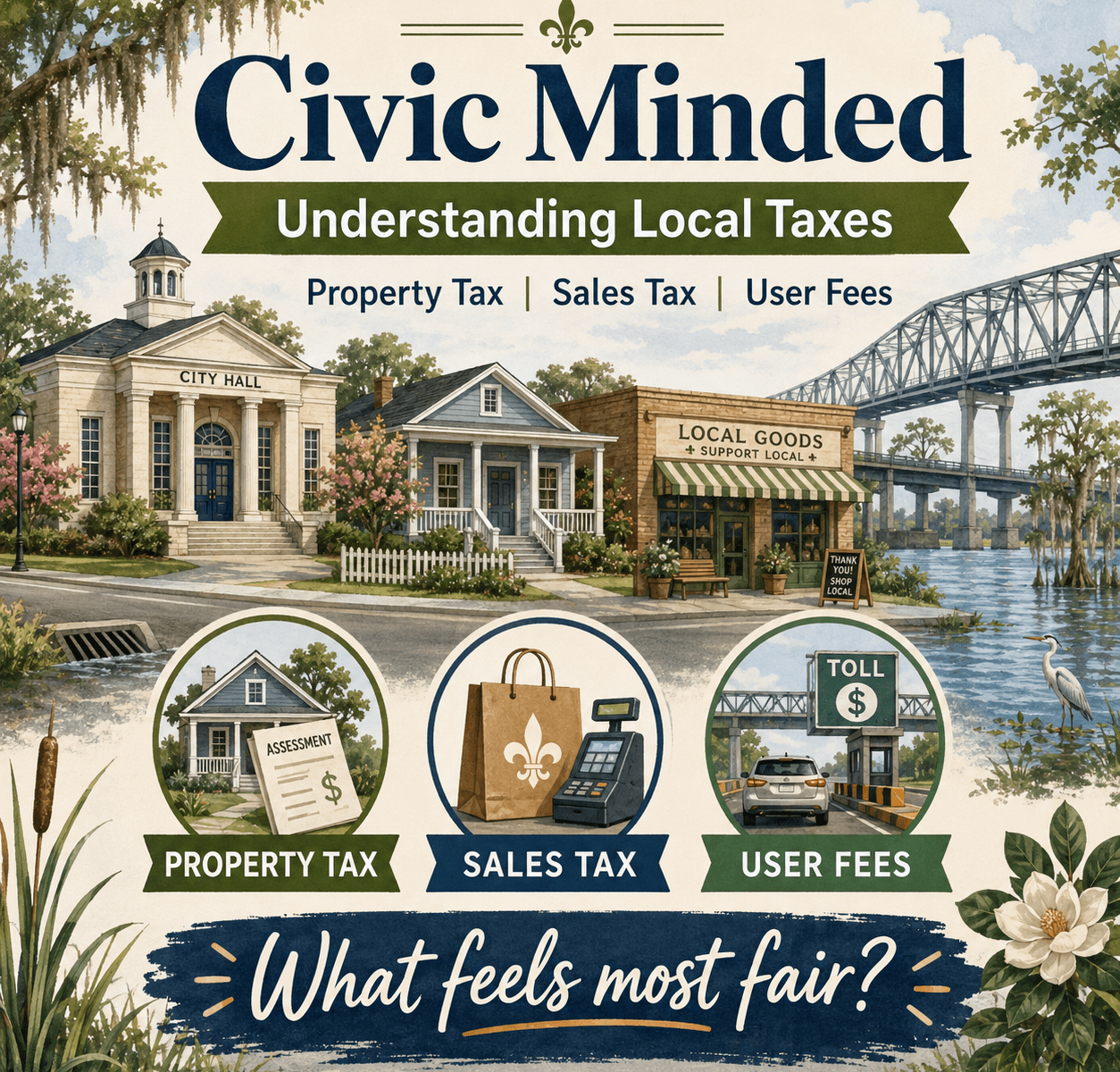
Here are three common ways local governments collect revenue in South Louisiana:
1. Property taxes
Property taxes are based on the assessed value of property, using what is called a millage rate. A millage is basically a tax rate applied to taxable property value.
One thing that often causes confusion is that a property tax is not like a sales tax. You are not paying it because you “bought” the property that year. You are paying it because you own property within a community that provides public services.
Even people who do not directly own property often still pay property taxes indirectly, because landlords generally build those costs into rent.
The argument in favor of property taxes is that they are relatively stable and predictable. Property values usually do not swing wildly from year to year, so local governments can plan long-term for roads, drainage, facilities, maintenance, public safety, and other services.
Property taxes are also often viewed as more progressive than sales taxes because people with higher-value property generally pay more. Homestead exemptions also help protect many homeowners from being taxed on the full value of their primary residence.
The downside is real, too. For seniors, retirees, or anyone on a fixed income, a property tax bill can feel like a sudden burden — especially if they do not have a mortgage escrow account setting money aside each month. And many people understandably ask, “Why am I still paying taxes on a house I already paid off?”
That’s a fair question. The answer is that the tax is not on the purchase loan. It is on the ongoing ownership of property within a community that continues to provide services.
2. Sales taxes
Sales taxes are probably the tax most people notice most often because we see them at the register.
They are based on what we buy.
The advantage is that they are fairly easy to understand and collect. They can also be useful in specific situations, such as a special district or corridor where businesses in that area help fund improvements in that same area.
But sales taxes are generally considered regressive, meaning they tend to hit lower-income households harder.
Why? Because basic needs do not shrink much just because someone earns less. A working-class family still has to buy food, clothing, household goods, school supplies, and other necessities. A larger share of their income goes toward taxable purchases.
For higher-income households, those same basic needs usually represent a smaller percentage of income.
Sales taxes can also be less dependable for long-term planning. They rise and fall with the economy. If people shop in a neighboring parish or city, those tax dollars help fund services somewhere else, not necessarily in the community where they live.
For example, if someone lives in Thibodaux but does much of their shopping in Terrebonne, their sales tax dollars may support Terrebonne services and facilities — not the recreation fields, roads, or drainage systems they use closer to home.
3. User fees and tolls
User fees are probably the most direct form of taxation or revenue collection.
You use the service, you pay the fee.
Tolls are a good example. In some ways, they feel very fair. If I use a toll road or bridge, I pay for that use. If I do not use it, I do not pay.
There is something appealing about that.
But user fees also have tradeoffs.
Some infrastructure is critically important even if only a small number of people use it every day. Think about a bridge that serves as the only way in and out of a small fishing community. It may be expensive to maintain, and the number of direct users may be limited, but that bridge may be a lifeline.
So the question becomes: should only the direct users pay, or does the broader society have some responsibility to help maintain access for that community?
There is also an administrative side. User fees can require extra systems for collection, accounting, enforcement, transparency, privacy, and maintenance. Sometimes the “fairest” method on paper becomes more complicated and expensive in practice.
That’s the challenge with taxation.
A good local tax system should probably try to do three things:
- Ask people to contribute in a way that is reasonably connected to the services and benefits they receive.
- Avoid placing an unfair burden on working-class families and vulnerable residents.
- Be practical enough to collect, manage, audit, and explain clearly to the public.
Again, there is no perfect system.
Property taxes are stable but unpopular.
Sales taxes are familiar but can hit lower-income households harder.
User fees can be fair but may not work well for every public service.
So here’s my question:
If local governments have to collect revenue — and they do — which type of system do you think is most fair?
Property taxes? Sales taxes? User fees? Some combination?
And more importantly: why?

