

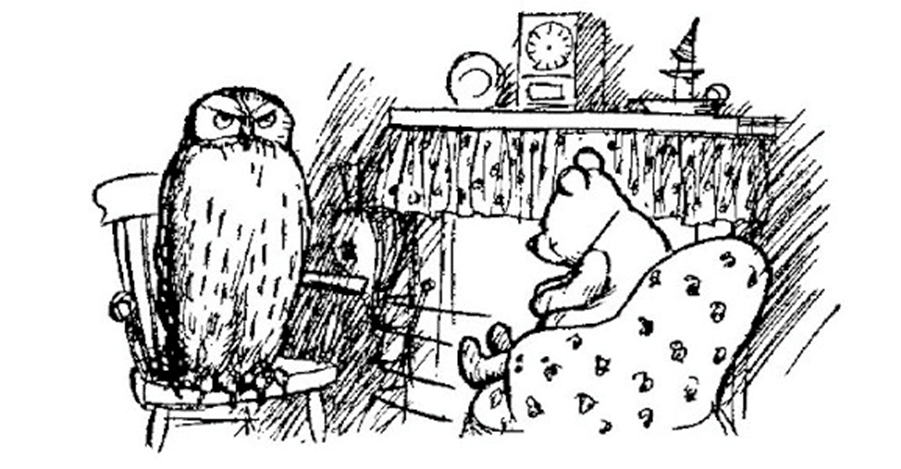
Next up in my study of owls is another harken back to childhood — A. A. Milne’s Owl of the Hundred Acre Wood.
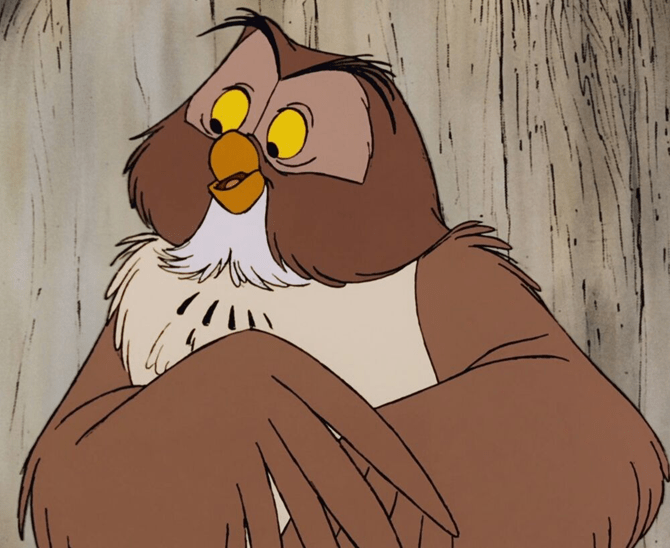
As a child, I always assumed Owl was the smart one of the group. He always had the ideas, spoke well, drank tea, and had lots of books in his neat house. Growing up and reading Milne’s original work, though, I see through Owl’s fluff into his real, somewhat tragic character. He plays the Wise Owl role, but can’t back it up with substance.
As a child, I always assumed Owl was the smart one of the group. He always had the ideas, spoke well, drank tea, and had lots of books in his neat little house. Growing up and reading Milne’s original work, though, I see through Owl’s fluff into his real, somewhat tragic character. He plays the Wise Owl role, but he can’t back it up with substance.
🦉 The “Wise” Owl Arrives
“And if anyone knows anything about anything,” said Bear to himself, “it’s Owl who knows something about something.”
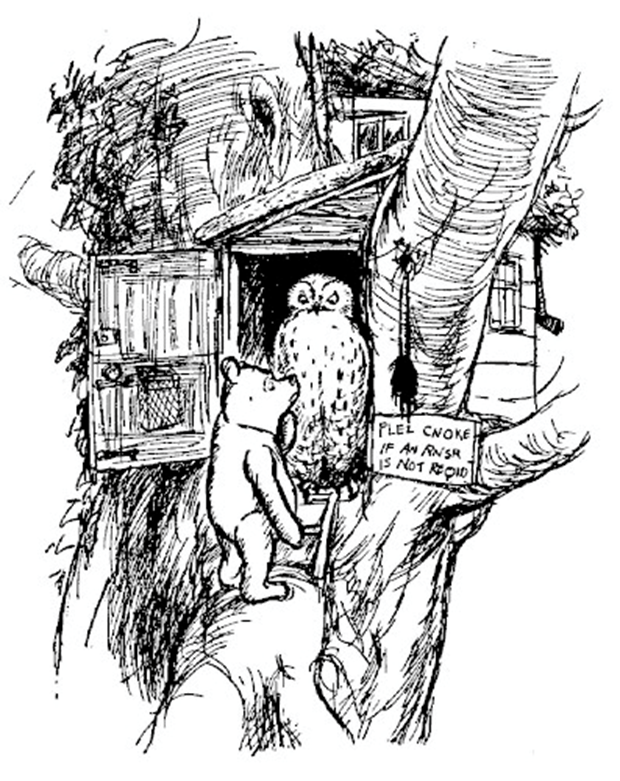
Of all the creatures in the Hundred Acre Wood, none wears the mantle of wisdom more proudly than Owl. He lives at The Chestnuts — an “old-world residence of great charm” that boasts both a knocker and a bell-pull. Beneath the knocker is a sign reading “PLES RING IF AN RNSER IS REQIRD,” and beneath the bell-pull, “PLEZ CNOKE IF AN RNSR IS NOT REQID.”
It’s a fitting introduction: Owl, the self-appointed intellectual, has his knocker and bell mixed up and can’t spell to save his feathers.
📜 The Reward That Wasn’t
When Eeyore loses his tail, Owl proudly proposes an idea to help:
“The customary procedure in such cases is as follows. First, issue a Reward.”
Pooh mistakes “issue a reward” for a sneeze, and Owl continues, “using longer and longer words,” until Christopher Robin must step in to actually write the notice.
Later, Owl shows off his new bell-pull — the very one that turns out to be Eeyore’s missing tail.
“I just came across it in the Forest… I rang it, and nothing happened, so I rang it again very loudly, and it came off in my hand.”
“Owl,” said Pooh solemnly, “you made a mistake. Somebody did want it.”
“Who?”
“Eeyore. My dear friend Eeyore. He was—he was fond of it.”
“Fond of it?”
“Attached to it,” said Winnie-the-Pooh sadly.
For all his clever talk, Owl literally cannot see what’s right in front of him.
🎂 The Scholar Who Can’t Spell “Birthday”
When Pooh asks Owl to help write “A Happy Birthday” on a jar for Eeyore, Owl gladly agrees — and proudly produces:
HIPY PAPY BTHUTHDTH THUTHDA BTHUTHDY
Pooh, ever kind, responds: “It’s a nice long one.”
Milne’s humor shines here. Owl’s pretense of intelligence turns absurd; he writes gibberish, lies to Pooh about what it says, and still congratulates himself for it.
🌳 The Know-It-All in the Woods
When Christopher Robin calls a narrow stream “the perfect place for an Ambush,” Pooh whispers to Piglet, “What sort of bush?” Owl interjects condescendingly:
“My dear Pooh, don’t you know what an Ambush is?”
He goes on to define it poorly, gets flustered when corrected, and ends the conversation in a huff. Owl knows words but misses meaning.
🌧️ The Flood and the Fool
During the great flood, when Piglet is stranded, Christopher Robin asks Owl for help. Owl When the Hundred Acre Wood floods, Christopher Robin asks Owl to fly and check on Pooh and Piglet. Owl agrees — but not before explaining that “the atmospheric conditions have been very unfavourable lately” and that “the flood level has reached an unprecedented height.”
“The who?” asked Christopher Robin.
“There’s a lot of water about,” explained Owl.
And even when Piglet is literally about to drown, Owl comforts him not with a plan, but with a “very long story about an aunt who had once laid a seagull’s egg by mistake.” Piglet is nearly swept away mid-anecdote.
Once again, Owl talks when he should act.
What This Owl Teaches Me (By Negation)
Owl impresses some—but not the ones who see clearly. Piglet, who constantly underestimates himself, sees right through the act:
“There’s Owl. Owl hasn’t exactly got Brain, but he Knows Things.”
And Piglet can read and write where Owl cannot. The “small” character is, in practice, the sharpest mind in the Wood.
For this Owl, I learn more about what not to be. Milne flips the trope: this isn’t a Wise Owl—it’s a performer. Lots of feathers, very little flight.
Receipts:
- Breaks what he doesn’t understand: literally pulled off Eeyore’s tail thinking it was a bell-pull, then hammers it t his own door without attaching it to any bell.
- Performs intelligence instead of practicing it: asks Pooh if he can read, then lies about what he wrote on Eeyore’s pot.
- Talks down instead of lifting up: scolds Pooh about an “Ambush,” but can’t solve the real problems—like planning Piglet’s rescue.
- Talks over people rather than speaking at their level; in the flood, nearly talks Piglet into danger with a pointless story.
Milne inverts the usual order: the “grown-up” posturing turns out vapid; the childlike humility gets the real work done. That sounds familiar:
“He called a little child to him… ‘Truly I tell you, unless you change and become like little children, you will never enter the kingdom of heaven… whoever takes the lowly position of this child is the greatest in the kingdom of heaven.’” — Matthew 18:2–4
So here’s my takeaway: Don’t chase the image of wisdom—practice the substance of it.
If I’m busy playing the Wise Owl, I’ll miss the simple, needed thing right in front of me. Image without substance might fool a few (like Owl fooled Christopher Robin), but it won’t accomplish much—and it can do harm (ask Eeyore’s tail… or Piglet on a windowsill).
Better to be small and sincere than grand and useless.
See clearly. Speak plainly. Do the good that needs doing.
#OwlWaysLearning
 Ramblings from That Guy